Topological acoustic devices
Investigating gigahertz acoustic propagation in patterned phononic structures using spatially resolved measurements.
Acoustic imaging · Phononic crystals
Quantum spin Hall effect in acoustic systems

In the electronic quantum spin Hall (QSH) effect, spin–orbit coupling inverts the bulk bands. At the boundary to an ordinary insulator, this creates edge states in which the electron’s spin is locked to its direction of travel.
Sound has no spin, but a lattice can be engineered to have one. In a hexagonal crystal, two degenerate pairs of modes form a “double Dirac cone” and act as an acoustic pseudospin. Shrinking or expanding the unit-cell features opens a band gap with either ordinary (“trivial”) or inverted (“non-trivial”) band order. Along an interface between the two, pseudospin-dependent edge states carry sound one way, and they are expected to be robust against bends and certain defects.
Imaging nanoscale acoustic metamaterials

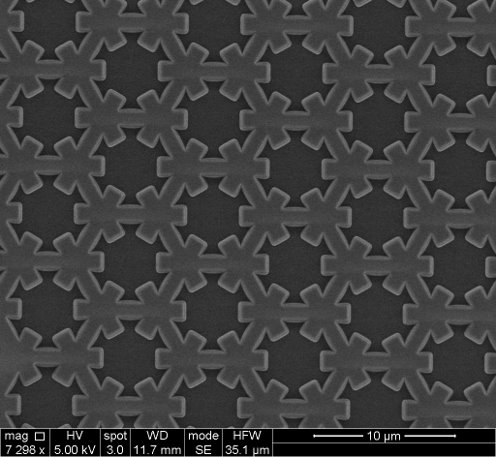
These ideas can be realized on chip. Snowflake-shaped phononic crystals etched into aluminum nitride (AlN) have a lattice constant of about 10 µm, so their band gaps sit near 1 GHz. This is the range TMIM can image.
In collaboration with Prof. A. T. Charlie Johnson’s group, we used TMIM to directly image the acoustic valley Hall effect (Nat. Electron. 2022) and acoustic Klein tunneling (Device 2024): perfect transmission of a Dirac-like acoustic wave through a potential barrier.
Acoustic quantum spin Hall at gigahertz frequencies

To build an acoustic QSH device at gigahertz frequencies, I used an inverse snowflake lattice: snowflake-shaped holes in an AlN film. Changing the size of the snowflake relative to the lattice constant (r₁/a₀) moves the lattice from the trivial phase to the non-trivial, band-inverted phase. Placing the two phases side by side creates an interface. In simulation, a wave injected at the interface stays confined to it.
Imaging the band gap and pseudospin transport

TMIM lets us check the topology directly in real space. I imaged the device at frequencies chosen relative to the simulated band gap (1.05, 1.07, and 1.10 GHz). At each frequency I compared where the acoustic signal lives: spread through the bulk of the lattice, or concentrated along the trivial/non-trivial interface.

Zooming in on the interface, the CH1 map shows a periodic field pattern along the boundary. This is the signature expected from pseudospin-polarized edge transport, and it can be compared directly with theoretical field patterns of elastic pseudospin states.
Why this matters: waveguides that are topologically protected could route gigahertz acoustic signals around sharp corners with low backscattering. That is a building block for compact phononic circuits in RF signal processing and quantum acoustics.
Possible application: a gigahertz topological ring resonator

One application of these edge states is a topological ring resonator. Closing the trivial/non-trivial interface into a loop gives a ring in which the edge mode circulates. Because the edge mode can turn sharp corners with little backscattering, the ring does not have to be a smooth circle; it can follow the lattice. A ring of this kind has been demonstrated for elastic waves at kHz frequencies (Nat. Commun. 9, 3072 (2018)). My simulation shows the same concept in a nanoscale phononic crystal operating at gigahertz frequencies. That makes it a candidate building block for compact on-chip acoustic filters and delay lines.
Project status — August 2024
Fabricated inverse-snowflake QSH devices were imaged with TMIM at gigahertz frequencies. A gigahertz topological ring resonator was explored in simulation as a possible application.